
There are places in New Zealand so remote that the landscape itself seems to guard them. Tucked deep into a valley, a family farm has quietly become one of the country's most dedicated producers of certified Organic Manuka Oil. Getting that oil into your hands is no small feat — and that, it turns out, is part of what makes it so extraordinarily antimicrobial.
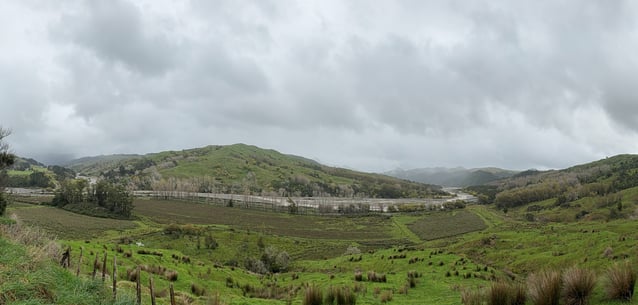
A Valley Wrapped in Mist and Manuka
Our grower in New Zealand is one of the rare few producing certified organic Manuka oil under a regenerative farming model. This is not a farm you stumble across. To get here from Auckland, you’ll need about a one-hour flight followed by a four-hour drive, assuming the roads are in good condition.
The Manuka Oil sits along winding rural roads that demand every shipment be carefully planned and consolidated. Once coordinated, the oil travels by road to the nearest port, where it is exported by air or sea to reach customers worldwide.
The valley itself is a world apart:
-
3 metres of annual rainfall — more than twice the national average
-
10,000 hectares of land — spanning forest, farmland, and plantation
-
16 full-time staff — most of whom are from the local Maori community or live on the farm
- 4.5 hours from the nearest port — the remoteness preserving pristine growing conditions
It operates less like a business and more like a community — shaped by the land, the seasons, and the people who have built their lives here.
Growing & Distilling Organic Manuka Oil
Manuka can technically be harvested year-round, but in winter, the conditions are too dangerous in practice. Notably, late summer, around February, is the critical harvest window. This is when triketone concentrations — the antibacterial compounds that give Manuka oil its therapeutic reputation — are at their highest. Miss the window, and the oil's quality reflects it.
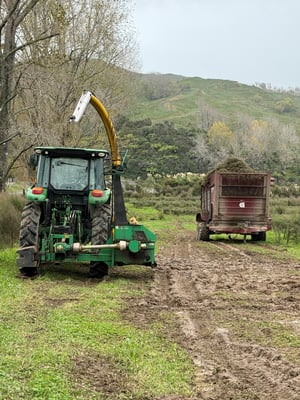
The harvest process:
-
A two-row modified harvester moves through high water content fields
-
Plants grown to 1.5 metres are cut back to 0.8 metres
-
Chopped biomass is shot directly into silage trailers running alongside
-
Trailers carry the fresh biomass directly to the on-site distillery
Inside the distillery, round stainless steel vessels are loaded via conveyor belt and carefully packed using a forklift-mounted tamper. Steam is pumped through the bottom of each vessel for approximately 5 hours. 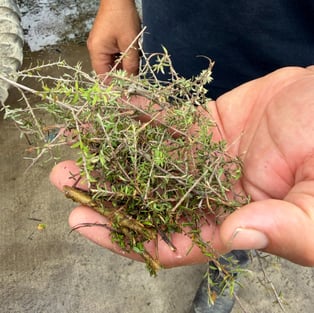
Only 0.2% of the biomass becomes oil
That means it takes 500kg of harvested Manuka plant material to produce just 1kg of oil. Every bottle represents an enormous weight of plant, labour, land, and time.
Every single batch is independently tested. The COA (Certificate of Analysis results confirm triketone levels — consistently ranging over 20%.
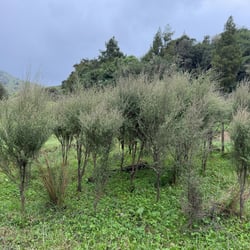 In New Zealand, Manuka is often called "tea tree" — a term most people associate with Australian Tea Tree Oil (Melaleuca alternifolia). Both plants have exceptional antimicrobial properties and work synergistically, but in terms of growth and yield, Manuka is far more delicate.
By comparison, the Tea Tree plant produces more biomass, yielding approximately 6 times as much oil as Manuka.
|
Manuka Oil Leptospermum scoparium |
Tea Tree Oil Melaleuca alternifolia |
|
|
Origin |
New Zealand |
Australia |
|
Plant Height |
around 1.5m |
>2m |
|
Harvesting |
two-row harvester |
multi-row harvester |
|
Harvest cut depth |
0.8m |
near ground level |
|
Harvest frequency |
Annual |
Annual |
|
Expected lifespan |
10-15 years |
30-40 years |
|
Biomass yield |
~ 0.2% |
~ 1.2% |
|
Biomass for 1 kg oil |
~ 500 kg |
~ 100 kg |
|
Agianst gram+ bacteria |
up to 1500 times more effective against Gram+ bacteria |
Broad spectrum antimicrobial and anti-inflammatory |
However, for some microorganisms, Manuka Oil can be up to 1500 times more effective than Tea Tree Oil. So you would only need a very small amount to achieve the same results. The two oils work in perfect synergy against the broad spectrum of nasty microbials.
Check our other blog posts to learn more about the benefits of Manuka and Tea Tree Oil:
Give your formula superpowers with our Dynamic Duo!
Manuka Oil - The Unknown Killer
Rooted in Organic and Regeneration
When you hold a bottle of our organic Manuka oil, you hold the result of months of careful cultivation, long-term community and environmental stewardship, and rigorous documentation and testing.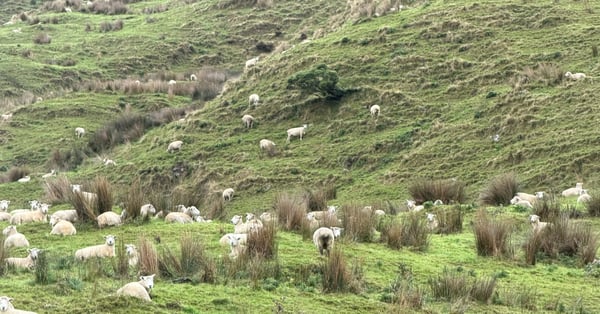
The farm operates entirely without synthetic pesticides. An annual Ecological Outcome Verification (EOV) program tracks the farm's real impact over time.
Sheep graze between the Manuka rows — keeping ground cover managed while naturally conditioning and fertilising the soil beneath their feet. The livestock numbers are closely monitored to assess soil pressure and build resilience.
Distillation biomass composted and returned to the land —so nothing gets wasted.
The steeper contour land is being retired and replanted with native bush through an on-farm nursery containing more than 40,000 native seedlings, perfectly adapted to valley conditions. Key species include Manuka, Kanuka, Kahikatea, and Flax.
Why It Matters
When you hold a bottle of our organic Manuka oil, you are holding the result of months of cultivation, sustainable investment in the community and nature, careful documentation and testing and our farm-to-bottle traceability promise. Every choice here is one our customers can stand behind — whether they're formulating a premium skincare range, a natural wellness product, or an OTC medicine exported worldwide.
Down Under Enterprises works with growers who farm this way. Because the brands that trust us deserve to know exactly where their ingredients come from — and be proud of the answer.


No Comment